Washington Sales Tax: Rates, Rules & Filing Guide

Washington Sales Tax Quick Facts | |
|---|---|
Washington state tax rate | 6.5% |
Max combined sales tax rate | ~10.5% |
Economic nexus threshold | More than $100,000 in retail sales sourced to Washington during the current or previous calendar year |
What sales count toward the threshold | Gross sales, including marketplace sales for individual sellers |
Tax authority | Washington Department of Revenue |
Tax portal | |
SaaS taxable? | Yes |
Administration difficulty | 3/5 |
Washington doesn't have a state income tax, but don't let that fool you into thinking it’s simple to deal with. It's one of the tougher states in the country when it comes to indirect tax. Washington taxes both B2C and B2B SaaS, which puts it in a small group of states that don't carve out an exception for business customers.
The state sales tax rate starts at 6.5%, but local tax rates can push the combined rate as high as 10.25% or more depending on where your customer is located. On top of that, Washington requires businesses to report Business & occupation tax (B&O) tax, a separate gross receipts tax, on the same return as sales tax.
This guide walks through how Washington sales tax works, what's taxable, when you need to register, how to calculate the right rate, and how to file and pay on time.
Taxable Categories: What Washington Sales Tax Applies To
Tangible Personal Property (TPP)
Physical goods are taxable in Washington by default. If you sell a physical product, you'll likely be required to charge sales tax at the combined state and local rate that applies to your customer's location.
There are some exemptions, like certain grocery items, prescription drugs and medical devices.
SaaS and Digital Goods
SaaS is generally taxable in the state of Washington. Digital products and downloaded software are also taxable. So whether your customer is streaming your software or downloading it, Washington wants its cut.
As of October 1, 2025, Washington expanded what counts as a taxable retail sale under law ESSB 5814. This brought a long list of services into the taxable category, including IT support, custom software development, custom website development, data processing, and data entry services.
If your business sells any of these services into Washington, you need to take a fresh look at your taxability determinations and ensure you’re charging correctly. Services that weren't taxable before October 2025 might be taxable now.
B&O Tax
Washington's Business and Occupation tax is a gross receipts tax. That means it's calculated on your revenue, not your profit. Even if your business operates at a loss, you still owe B&O tax on what you bring in.
B&O tax is technically a direct tax, not an indirect tax. But Washington reports it on the same excise tax return as sales tax, so it's something every business selling into Washington, even if you are not based there, needs to account for.
Many SaaS and tech companies fall under the "Service and Other Activities" B&O classification. As of October 1, 2025, this classification has three tiers based on your prior calendar year's taxable income:
- Under $1 million: 1.5%
- $1 million to $4,999,999.99: 1.75%
- $5 million or more: 2.1%
Hospitals and select advanced computing businesses are exceptions and stay at the 1.5% rate regardless of revenue.
If Sphere handles your Washington compliance, we cover B&O reporting right alongside your sales tax filing. You won't need a separate workflow to handle this extra tax reporting and filing.
Monitoring: When Washington Sales Tax Applies to You
Economic Nexus Threshold
Washington's economic nexus threshold is $100,000 in sales in the current or previous calendar year. Washington generally looks at retail sales sourced to Washington, including taxable and exempt retail sales when it comes to economic nexus. In general, even if most of what you sell to Washington customers is exempt, those sales still count toward the $100,000 number.
Sphere monitors your sales against nexus thresholds across all US states, including Washington, and alerts you when you're getting close to the trigger point. That way you're not caught off guard when you cross the line.
Physical Nexus
Any physical presence in Washington creates sales tax nexus. That includes an office, an employee, a contractor, or stored inventory. This is even if you are a remote seller headquartered elsewhere.
If you have a remote employee living in Washington, that alone can create physical nexus for your business, regardless of how much revenue you're bringing in from the state. Remote work has made this kind of nexus a lot more common than it used to be.
Registration: How to Register for Washington Sales Tax
How to Register
To register for Washington retail sales tax, you'll complete a Business License Application through the Washington Department of Revenue. This can be done online, and processing generally takes one to two weeks.
One registration covers both your sales tax and B&O tax obligations under a single account, which simplifies things compared to states that require separate registrations for different tax types.
Registration Fees
There is no specific fee to register for Washington state sales tax, but you may also need to apply for a business account, which comes with a $50 fee.
If you'd rather not deal with the application yourself, Sphere can manage the full registration process with Washington DOR on your behalf, from filling out the application to submitting it.
Calculation: Washington Sales Tax Rates
State and Local Rates
Washington's state base sales tax rate is 6.5%. On top of that, cities, counties, and special transit districts can add their own local rates.
Local add-ons can bring the combined rate up to around 10.25% to 10.6% in some areas, particularly in parts of King County where multiple local taxes stack on top of each other.
Destination-Based Sourcing
Washington uses destination-based sourcing. That means the tax rate you charge is based on where your customer receives the product or service, not where your business is located.
This matters a lot if you sell to customers across Washington, because the same product can be taxed at very different rates depending on which city or county your customer is in.
Here are the combined rates in a few major Washington cities:
City | State Rate | Local Rate | Combined Rate |
|---|---|---|---|
Seattle | 6.5% | ~4.05% | ~10.55% |
Bellevue | 6.5% | ~3.8% | ~10.3% |
Tacoma | 6.5% | ~3.7% | ~10.2% |
Spokane | 6.5% | ~2.4% | ~8.9% |
These numbers shift over time as local jurisdictions add or adjust their rates. Because of how granular Washington's rates can get, even down to specific addresses within the same ZIP code, it's a good idea to use the Washington Sales Tax Calculator Tool to confirm the exact rate for a specific address for your tax calculations.
Filing: How and When to File Washington Sales Tax Returns
Filing via MyDOR / SAW
Washington requires all returns to be filed electronically through the state's online portal, My DOR. Your B&O tax is reported on the same return as your sales tax, so you're not filing two separate forms.
Filing Deadlines
Returns are due on the 25th day of the month after the end of your reporting period. If the 25th falls on a weekend or public holiday, the deadline moves to the next business day.
Filing Frequency
Washington DOR assigns your filing frequency, monthly, quarterly, or annual, based on your estimated yearly business income and tax liability when you register. They'll send you this information after you complete registration.
Filing Frequency | Volume Threshold |
|---|---|
Monthly | Over $4,800 annual estimated tax liability |
Quarterly | $1,050 to $4,800 annual estimated tax liability |
Annually | Less than $1,050 annual estimated tax liability |
If your business grows or shrinks significantly, you can request a change to your filing frequency by contacting Washington DOR directly.
Late Filing Penalties
Washington uses an escalating penalty structure for late filings:
- 9% penalty starting the day after your due date
- 19% penalty if the tax remains unpaid by the last day of the month following the due date
- 29% penalty if the tax remains unpaid by the last day of the second month following the due date
The minimum penalty for late payment is $5. Washington also charges interest on unpaid tax, and the interest rate changes every year, so check the current rate on the Washington DOR website before estimating what you might owe.
Remittance: How to Pay Washington Sales Tax
Remittance via MyDOR / SAW
Once you've filed your return through My DOR, you'll pay what you owe using a US bank account. Washington processes payments through ACH debit directly from your account.
Remittance for Foreign Businesses
If your business doesn't have a US bank account, paying Washington DOR directly can be a hurdle. Sphere's embedded remittance platform handles this for you, so foreign businesses can stay compliant in Washington without needing to open a US bank account.
How Sphere Helps With Washington Sales Tax Compliance
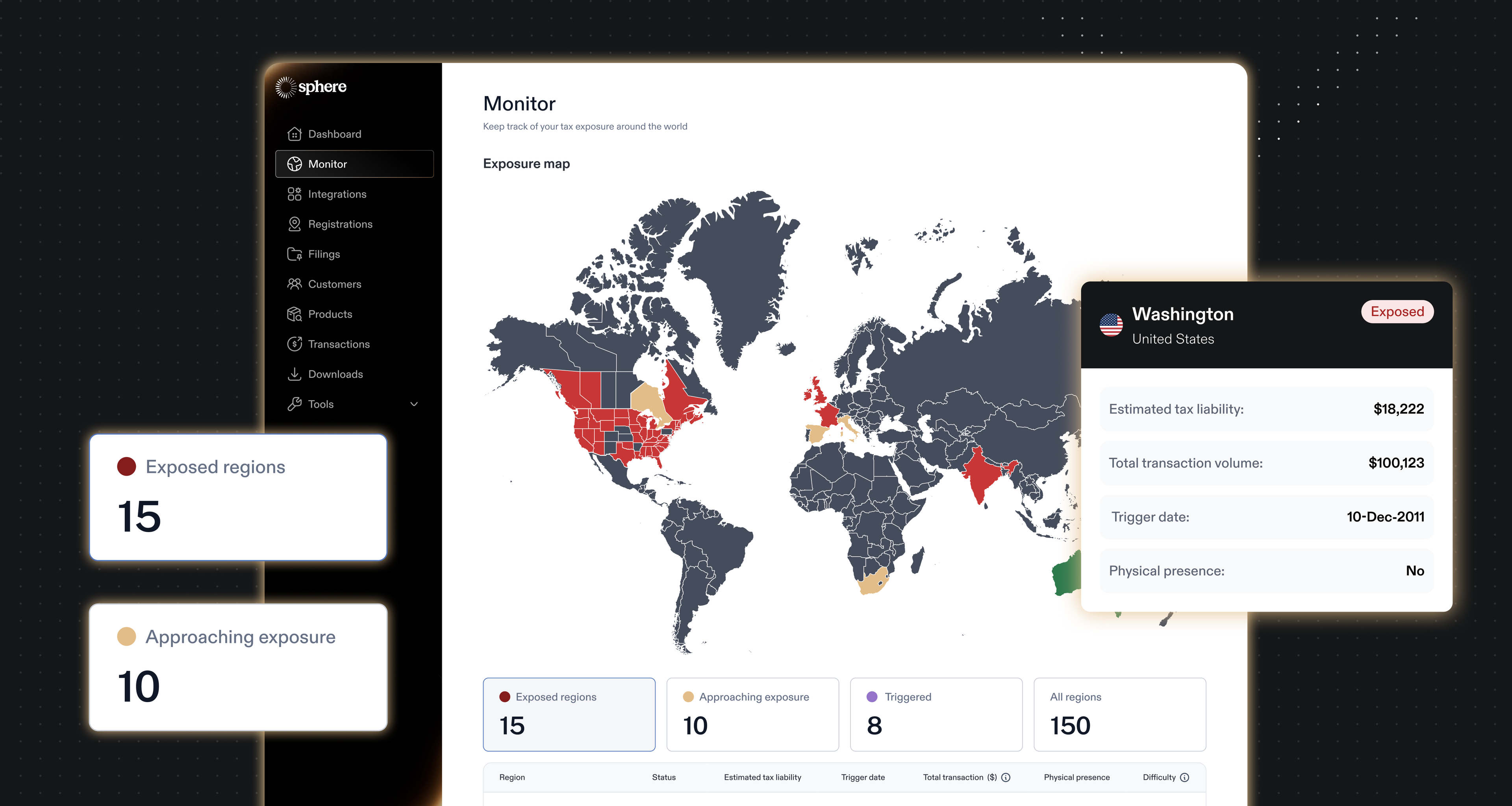
In Washington, who you're selling to, what you're selling, and exactly where your customer is located all affect your tax obligations. Add the B&O tax on top, and it's easy for things to slip through the cracks at filing time.
Sphere takes care of the whole process for Washington state:
- Monitors your sales against Washington's $100,000 nexus threshold and flags it before you cross the line
- Classifies SaaS transactions correctly and applies destination-based rate logic automatically
- Handles B&O tax reporting alongside your sales tax filing, so there's no separate process to manage
- Manages exemption certificates and supports foreign businesses through embedded remittance