Turkey Digital Services Tax: Complete Guide

This article was written in collaboration with Penezoğlu Law Firm (Ayşe Uzun Nurili, Director)
In force since March 2020, Turkey’s Digital Services Tax (DST) applies to any digital services provider who meets two thresholds, no matter if they have any physical presence in the country.
The current rate is 5%, which is reduced from 7.5%, with a further drop to 2.5% scheduled for January 1, 2027 under Presidential Decision No. 10767.
Failing to register or missing a filing can result in significant penalties for businesses with customers in Turkey (Türkiye). The Turkish Revenue Administration can assess back taxes, levy a penalty equal to the full amount of unpaid tax, and charge late-payment interest. If your business sells digital services like SaaS into Turkey, you need to understand this tax.
This guide covers what the tax is, who owes it, what services are in scope, how to calculate and file it, what happens if you don't, and where Turkey fits in the broader European DST picture.
What Is Turkey's Digital Services Tax?
Turkey's DST is a tax on gross revenue from digital services delivered to users in Turkey. It is administered by the Turkish Revenue Administration (TRA). The legal basis is tax Law No. 7194, which came into force on March 1, 2020.
Definition and Purpose
The DST is a revenue tax, not a profit tax. That distinction matters: there are no deductions for costs, inputs, or expenses. You owe the tax on whatever you earn from qualifying services in Turkey.
The tax applies regardless of where the provider is based. A company headquartered in the US, Germany, or Singapore owes DST if it meets the thresholds. Your company is not required to have a permanent establishment in Turkey to be subject to the tax.
Turkey introduced the DST in March 2020 in order to tax value created in the digital economy. It focuses on digital advertising, online content, and platform-based intermediation services (i.e. online marketplaces). While OECD Pillar One talks may set standards for a wider DST tax across signatory nations, those talks are still unresolved, and Turkey continues to maintain its DST.
Tax Base
The tax base is gross revenue from qualifying digital services attributable to Turkish users. No input deductions are allowed. It’s important to note that under Article 5/2 of Law No. 7194, the DST cannot be shown as a separate line item on customer invoices. Doing so carries penalties under the Tax Procedure Law.
Note also that DST and VAT are separate obligations. Foreign digital service providers that do not meet the DST thresholds may still face VAT registration requirements under a distinct framework. This guide covers DST only. Providers should assess their VAT exposure separately.
Who Must Pay Turkey's Digital Services Tax?
Not every digital business selling into Turkey owes Turkey DST. Two revenue thresholds must both be met before liability kicks in.
Dual Revenue Thresholds
Both the following must apply in the prior accounting period before a business is required to collect Turkey’s DST:
- The business makes €750 million or above in global revenue
- The business makes TRY 20 million (approximately €378,000 in Turkish lira as of May 2026) or above in Turkish local revenue
These thresholds apply regardless of whether the business has physical presence or a permanent establishment in Turkey.
Note that this applies to the entire business, not just a subsidiary. Therefore, an individual local entity of a larger corporation cannot argue that it falls below one of these thresholds on its own. The entire business group’s consolidated revenue thresholds apply.
Entity Types in Scope
The DST applies to:
- Foreign digital service providers with no Turkish establishment
- Turkish-resident companies providing qualifying digital services
Both resident and non-resident providers are on the hook for DST. For foreign providers, there is no requirement to appoint a Turkish tax representative, though doing so is an option.
Which Digital Services Are Taxable?
Categories in Scope
Three categories of digital services trigger DST liability under Law No. 7194:
- Digital advertising services - including ad targeting, programmatic advertising, sponsored content placement, and the sale or processing of user data for advertising purposes. This captures ad networks, demand-side platforms, data brokers monetizing behavioral data, and social media platforms deriving revenue from Turkish user views.
- Digital content - the sale, licensing, or streaming of audio, video, games, software, and digital publications. This includes music and video streaming platforms, app stores, mobile games, e-book platforms, and downloadable software. Note that the category turns on how software is delivered and monetized: a perpetual software license and a cloud-based SaaS subscription may be treated differently depending on whether the service is characterized as content delivery or platform intermediation.
- Digital platform and marketplace services - platforms that facilitate transactions or interactions between users, whether commercial or non-commercial. This covers e-commerce marketplaces, ride-hailing and food delivery platforms, freelance and gig economy platforms, accommodation booking platforms, and social networks that derive revenue from facilitating user-to-user engagement.
This covers a wide range of business models, including streaming platforms, app stores, ad networks, online marketplaces, and many software subscription services (SaaS) services.
Note that a single provider may have DST exposure across multiple categories simultaneously. For example, a major app store generates revenue from advertising, content/app sales, and marketplace intermediation, each requiring separate revenue attribution. SaaS products require fact-specific analysis: classification depends on the function of the service and how it is delivered, not simply whether it is subscription-based.
AI Services and the DST
Law No. 7194 was drafted in 2019 and its three service categories do not address AI-delivered services. The TRA has issued no specific guidance on how generative AI, large language model APIs, or AI-powered tools map onto the existing categories. This creates meaningful classification uncertainty for a fast-growing class of providers.
In the absence of guidance, the correct approach is to characterize AI services by their economic substance under the existing framework.
- Consumer-facing AI subscription tools (such as AI assistants, image generators, and productivity applications) most plausibly fall under the digital content category, as they deliver software-based functionality to end users via a digital platform.
- AI API access sold to developers is more ambiguous, as it may qualify as digital content (software/application access) depending on characterization.
- AI-powered advertising tools fall squarely within the digital advertising category regardless of the AI component; the revenue is from advertising services.
- AI features embedded within platform services are ancillary and are characterized by reference to the primary service.
AI companies that meet the DST thresholds and mischaracterize their services as out-of-scope face the full penalty and interest on historical periods. Until the Turkish Revenue issues a communiqué addressing AI services directly, providers should seek specific advice before concluding they fall outside scope.
What Is Excluded
Law No. 7194 exempts five categories of services, all already subject to other Turkish tax frameworks:
- Mobile/electronic communications subject to treasury share payments under Telegraph and Telephone Law No. 406
- Telecommunications services subject to Special Communication Tax
- Banking services under the Banking Law
- R&D center products arising from licensed Turkish R&D Center activity (foreign R&D does not qualify)
- Payment services under Law No. 6493 provided by licensed payment institutions only, not payment features embedded in broader platforms
Current Rate and Scheduled Reductions
Turkey’s DST rate has already changed twice since its inception in 2020.
Period | Rate | Legal Basis |
|---|---|---|
1 March 2020 – 31 December 2025 | 7.5% | Law No. 7194, Article 5 |
1 January 2026 – 31 December 2026 | 5% | Presidential Decision No. 10767 |
1 January 2027 and forward | 2.5% | Presidential Decision No. 10767 |
Presidential Decree No. 10767 was published in the Official Gazette on 25 December 2025 and entered into force on that date, applying to revenues generated as of 1 January 2026.
If your company has historical filing gaps, that rate history is important. Returns covering periods before 2026 should use the 7.5% rate. Note also that the applicable late-payment interest rate varied across periods (see Enforcement section below). A blended calculation is required for gaps spanning multiple rate windows.
How Turkish DST Is Calculated and Filed
Calculating the Tax
Calculating Turkish DST is straightforward. Apply the applicable rate to gross revenue from qualifying digital services delivered to Turkish users in the relevant period. There are no input deductions and no credits to offset.
Also note that DST paid is deductible as a business expense in Turkey under Article 6/7 of Law No. 7194 for corporate or income tax purposes. However, this deduction is only useful if the provider has a local taxable presence in Turkey. Most foreign companies filing remotely will not benefit from the deduction.
Filing Cadence and Payment
DST is due monthly. Returns and payments are both due by the end of the month following the relevant taxation period. For example, your January DST return and payment is due by the last day of February.
Foreign providers without a Turkish establishment are required to register directly through the Turkish Revenue Administration's dedicated Digital Services Tax portal at digitalservice.gib.gov.tr and file Form No. 1 DST Return. Appointing a Turkish tax representative is optional, not mandatory, but some providers find it helpful for managing correspondence with the relevant tax office.
Enforcement and Non-Compliance Risk
Failing to register, file, or pay DST triggers a full historical assessment by the Turkish Revenue Administration. The consequences stack up quickly:
- Tax assessed on all prior periods where DST was owed
- A tax loss penalty equal to one-fold of the assessed tax
- Late-payment interest at the rate applicable to each period: currently 3.7% per month (from 13 November 2025), 4.5% per month between May 2024 and November 2025, with earlier rates applying to periods before May 2024. Blended calculations are required for multi-year gaps
- of 3.7% per month for periods starting November 2025 (approximately 44% annually) calculated from the date the tax was originally due. (Note that different late payment interest rates apply for different periods. For example, the delay interest rate was 4.5% for the period from May 2024 through November 2025.)
At 44% annual interest (54% for certain periods), a multi-year filing gap can turn a manageable liability into a significant one fast. It’s vital to understand your liability for Turkish DST.
Disputing An Assessment
If you receive an assessment you believe is wrong, you must file a petition with the competent tax court within 30 days of the assessment notice. Tax court proceedings in Turkey typically run 18 to 36 months through first instance and appeal. The disputed tax is not always required to be paid until an unfavorable decision is rendered during that time, but penalties and interest continue to accrue while the case is open.
Invoice Restrictions
DST cannot be itemized as a separate line on customer invoices under Article 5/2 of Law No. 7194. This applies to all providers. Violations carry penalties under the Tax Procedure Law. This creates a practical tension for providers using global billing platforms that are configured to display tax line items by default; billing systems must be reviewed for Turkey-specific compliance.
Digital Services Taxes in Europe, 2026
Where Turkey Sits in the European DST Landscape
Turkey is one of several countries in and around Europe that operates a DST. The table below shows the current state of DSTs across the region as of 2026.
Country | DST Rate | Status | Notes |
|---|---|---|---|
Turkey | 5% | In force | Phased reduction to 2.5% in process |
France | 3% | In force | Applies to digital intermediation and online advertising |
Italy | 3% | In force | Applies to digital intermediation and advertising |
Spain | 3% | In force | Applies to digital intermediation and advertising |
UK | 2% | In force | Applies to search engines, social media, online marketplaces |
Austria | 5% | In force | Applies to digital advertising only |
Poland | Proposed | Pending | Not yet enacted as of June 2026 |
OECD Pillar One and the DST Outlook
The OECD’s Pillar One aims to reallocate taxing rights over large multinationals to market jurisdictions, which would theoretically make standalone DSTs redundant for countries that sign on. But progress has been slow and countries are impatient to tax what they see as a major source of revenue.
Turkey's adoption of a rate reduction came against the backdrop of a competing proposal to raise the rate from 7.5% to 12.5%, making the reduction a meaningful policy signal. It does not, however, signal abolition. Foreign providers should plan for DST at some level to continue for the foreseeable future.
What Foreign Providers Should Do Now
If you sell digital services and have meaningful revenue from Turkish users, here is where to start:
- Check your thresholds. Confirm whether your consolidated group exceeds both the €750 million global threshold and the TRY 20 million Turkish revenue threshold. Both must be met in order for you to be liable for DST.
- Classify your services correctly. If your business delivers AI-powered tools, SaaS products, or hybrid platform/content services, obtain specific advice on how your revenue streams map to the three DST categories before concluding you are in or out of scope.
- Assess historical exposure. If you have been in scope since 2020 but have not filed, the 7.5% rate applied through December 2025. A nexus study covering that period will tell you what you may owe before interest and penalties.
- Register with the TRA. Foreign providers register directly via the Digital Services Tax portal at digitalservice.gib.gov.tr. Also decide whether to appoint a Turkish tax representative for voluntary disclosure procedure for the previous periods.
- Set up monthly filing workflows. Returns and payments are due monthly, by the end of the following month. This needs to be built into your compliance calendar.
- Update billing systems for January 1, 2027. The rate drops to 2.5% on that date. Any cost modeling or pricing built on the current 5% rate will need to be adjusted. Also review billing system configurations to ensure DST is not displayed as a separate invoice line item, which carries its own penalty exposure.
- Assess VAT obligations separately. DST and Turkish VAT are distinct frameworks with separate registration thresholds and filing obligations. Meeting the DST thresholds does not determine your VAT position.
How Sphere Helps With Turkey DST Compliance
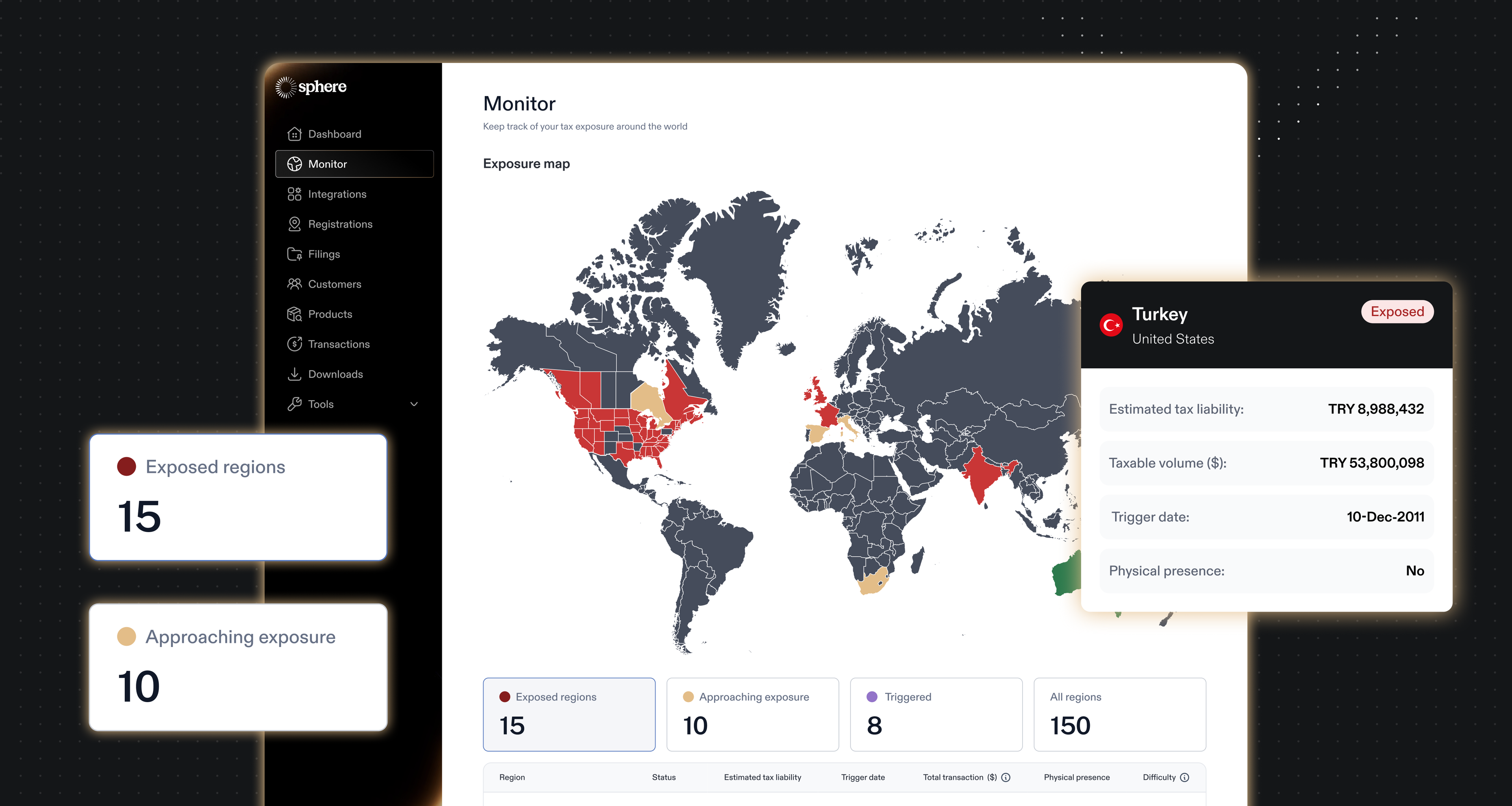
Sphere monitors indirect tax obligations across global jurisdictions, including Turkey's DST thresholds and rate changes. As Turkey's rate moves from 5% in 2026 to 2.5% in 2027, Sphere automatically applies the correct rate to your calculations so your finance team does not have to catch the change manually.
Beyond Turkey, Sphere automates registration, calculation, and filing workflows across the EU, UK, and other major markets, giving you a single compliance standard instead of a patchwork of spreadsheets and manual reminders.